
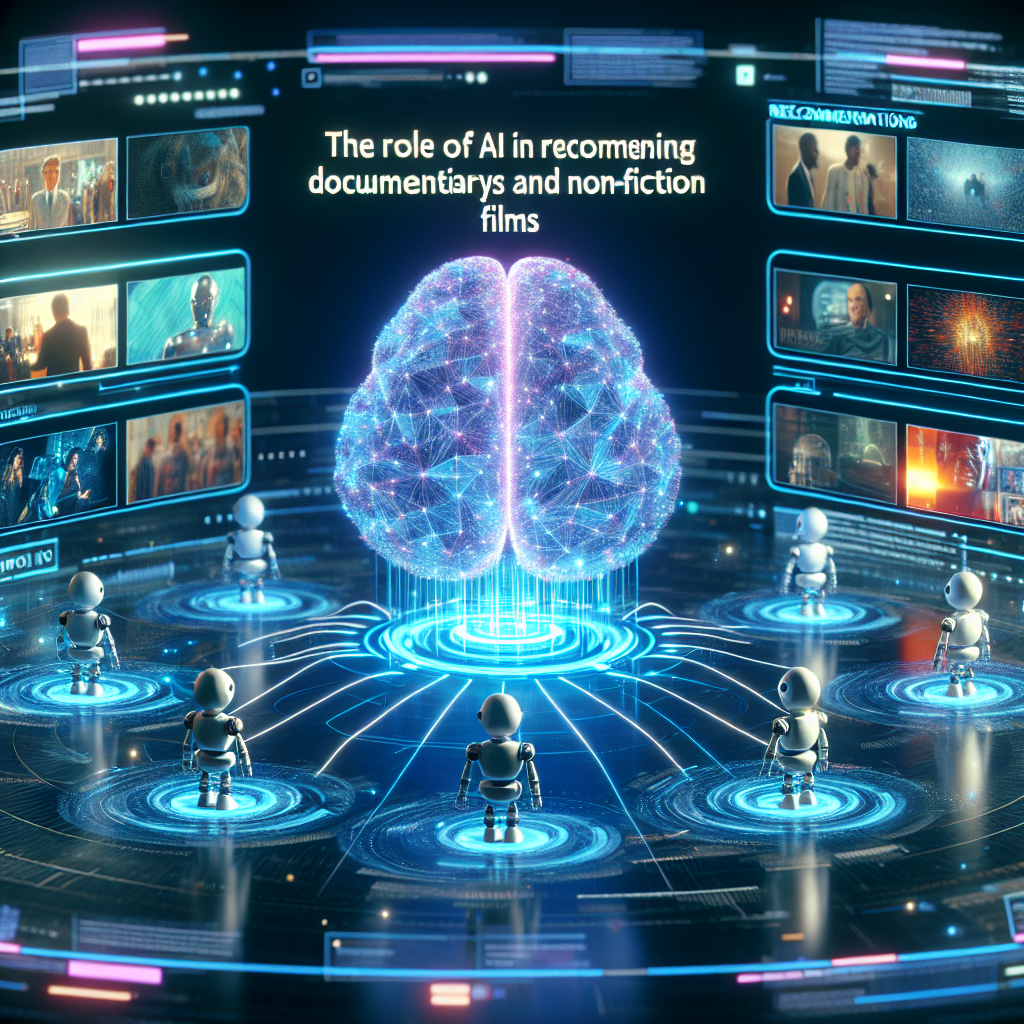
In today’s era of digital streaming, the sheer abundance of available content can be overwhelming. For documentaries and non-fiction films, the demand for personalized recommendations has never been higher. Enter Artificial Intelligence (AI)—a revolutionary technology transforming the way audiences discover new content. In this article, we’ll explore how AI plays a crucial role in recommending documentaries and non-fiction films, enhancing the viewing experience by connecting audiences with content that aligns with their interests.
Article Outline
- Introduction to AI in Film Recommendations
- Understanding User Preferences
- Personalized Recommendation Engines
- AI Techniques in Recommendation Systems
- Enhancing User Experience
- Future Trends and Developments
- Conclusion
Introduction to AI in Film Recommendations
**AI technologies** have become integral in the film industry, especially in streaming services like Netflix and Amazon Prime. The diverse catalog of documentaries and non-fiction films presents an untapped opportunity for viewers to explore new subjects. AI assists by tailoring recommendations based on individual preferences, viewing history, and behavior.
Understanding User Preferences
The magic behind accurate film recommendations lies in understanding user preferences. AI systems analyze **data points** such as:
- Past viewing history
- User ratings and reviews
- **Search queries** and user interaction patterns
- Time spent on particular content
By analyzing these data points, AI can predict which documentaries or films a viewer might enjoy next, thus **enhancing the user experience**.
Personalized Recommendation Engines
**Personalization** is key when it comes to engaging users with content that feels uniquely chosen for them. Recommendation engines driven by AI utilize an array of methods to ensure users find content that resonates with their specific interests. The most common approaches include:
- **Collaborative filtering**: Recommends items based on the behavior of similar users.
- **Content-based filtering**: Suggests films with similar features to those the user has previously enjoyed.
These methods allow streaming platforms to deliver a **customized viewing experience**.
AI Techniques in Recommendation Systems
AI utilizes a host of techniques to make recommendations more accurate:
- **Machine Learning Algorithms**: Train systems using vast datasets to identify patterns and preferences.
- **Natural Language Processing (NLP)**: Analyzes user reviews and descriptions to detect trends and preferences.
- **Deep Learning**: Enhances predictive capabilities by processing complex datasets.
These techniques allow AI to refine its recommendations over time, constantly improving as more data is gathered.
Enhancing User Experience
The implementation of AI in recommendation systems does more than just provide suggestions; it transforms user interaction by:
- **Saving time**: Quickly connects users with content, eliminating the need to scroll endlessly.
- **Discovering new interests**: Introduces viewers to content outside their typical preferences, expanding their horizons.
- **Increased engagement**: Higher satisfaction with recommendations leads to more viewership and retention.
These enhancements ensure users have a more **satisfying and immersive** experience.
Future Trends and Developments
As AI continues to develop, the scope for future innovations in film recommendations is enormous. Emerging trends include:
- Integration of **virtual reality** for more immersive previews.
- Use of **augmented reality** to provide interactive recommendations.
- Advanced **emotion recognition technology** for mood-based content suggestions.
These trends signify a future where recommendations become even more precise and tailored.
Conclusion
The role of **AI in recommending documentaries and non-fiction films** is transformative, continuously evolving to meet user needs more efficiently. By understanding viewer preferences and utilizing advanced technologies, AI-driven recommendation systems offer a highly personalized and engaging user experience. As advancements continue, audiences can look forward to an even more dynamic and intuitive viewing journey.