
“`html
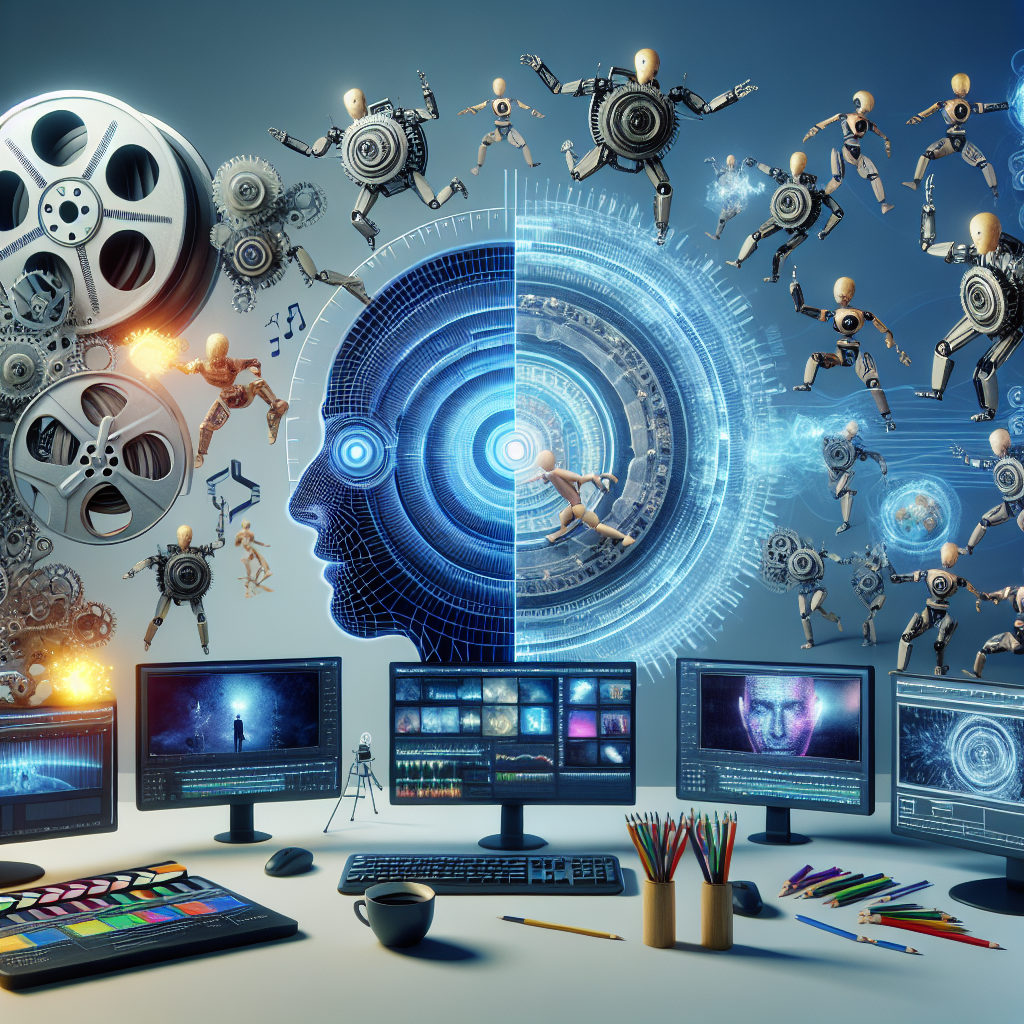
The landscape of film production has undergone a seismic shift in recent years, thanks largely to the advent of artificial intelligence (AI). **AI is now an integral part of the creative process**, enabling filmmakers to push the boundaries of storytelling, editing, and animation. This technological revolution is not just reshaping how films are made, but also redefining human creativity in the industry. As AI tools become more sophisticated, they offer filmmakers new ways to conceptualize, create, and refine their projects. This article delves into the transformative impact of AI on human creativity in film production, examining how technology has become a catalyst for innovation in the cinematic world.
- Transforming Scriptwriting
- Revolutionizing Editing
- Advancing Visual Effects and CGI
- Enriching Animation
- Enhancing Audience Engagement
- Ethical Considerations and Challenges
Transforming Scriptwriting
The script is the soul of any film, and AI is making its mark even at this foundational level. **AI tools for scriptwriting** now help writers brainstorm ideas, develop characters, and flesh out plots. Platforms like ScriptBook employ algorithms to analyze script potential, elevating the creativity of screenwriters by providing data-driven insights. AI can suggest storylines or character developments by analyzing thousands of scripts for patterns and successful elements, helping writers overcome blocks and experiment with novel ideas.
- AI analyzes existing scripts to suggest trends and successful structures.
- Assists writers in overcoming creative blocks with new plot ideas.
- Predicts a script’s commercial success through data analysis.
Revolutionizing Editing
Editing has traditionally been a labor-intensive process, but AI tools are now **streamlining post-production**. Adobe’s Sensei and other AI-driven technologies can automatically edit film footage by detecting key scenes and highlights. Algorithms can sift through hours of video to find the best shots, cutting down on editing time and allowing editors to focus on polishing the narrative.
- AI automates the identification and assembly of highlight scenes.
- Reduces editing time through efficient scene navigation.
- Enables editors to focus on enhancing narrative coherence and style.
Advancing Visual Effects and CGI
Visual effects (VFX) and computer-generated imagery (CGI) are at the forefront of AI integration in film. Tools like DeepImageFakes have taken CGI to new heights, allowing filmmakers to generate highly realistic images and effects that were previously unachievable. **AI enhances VFX creation by learning from vast datasets of images**, producing effects that are both cost-effective and time-saving.
- AI-generated VFX offer unprecedented realism and detail.
- Reduces costs by minimizing manual animation work.
- Speeds up production with quick rendering times.
Enriching Animation
In the world of animation, AI is breaking barriers by generating complex animations that would be difficult to create manually. Software like Autodesk’s Maya now uses AI to streamline the animation process, facilitating real-time motion capture and facial recognition. This **speeds up production timelines** while maintaining high-quality standards.
- Facilitates real-time motion capture for seamless animations.
- Utilizes facial recognition for accurate character expressions.
- Reduces manual workload and accelerates project delivery.
Enhancing Audience Engagement
AI’s influence extends beyond production into audience engagement. Predictive analytics help filmmakers and distributors understand audience preferences, tailor marketing campaigns, and even determine optimal release strategies. **By leveraging AI, films can resonate more deeply with audiences**, ensuring both critical acclaim and box office success.
- Identifies target demographics with improved precision.
- Customizes promotional content to enhance viewer interest.
- Suggests the best release times for maximizing audience reach.
Ethical Considerations and Challenges
Despite the many benefits AI brings to film production, it also raises important ethical questions. Concerns about intellectual property, data privacy, and the potential for job displacement in the industry are increasingly prominent. **Balancing technological advancement with ethical responsibility** is crucial to ensuring AI is used to enhance, rather than exploit, human creativity in film.
- Addresses intellectual property rights with AI-generated content.
- Ensures data privacy in AI-driven analytics.
- Navigates potential job displacement amid increased automation.
In conclusion, AI has undeniably transformed the landscape of film production, offering innovative opportunities for creativity while streamlining traditional processes. As the film industry continues to evolve, the harmonious integration of AI holds the potential to unlock new realms of storytelling and visual artistry, ensuring that filmmakers can continue to **captivate audiences in ways never before imagined**.
“`